
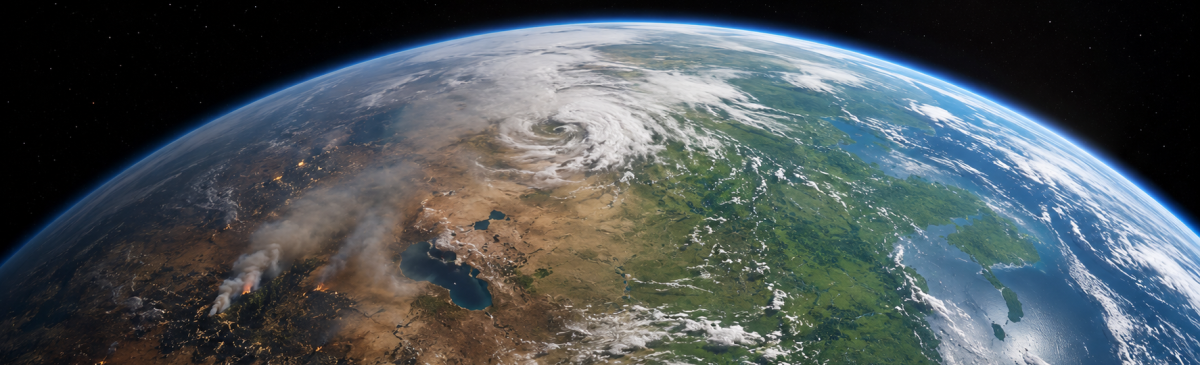
Earth’s vital signs are like planetary health indicators, and all of them tell us that climate change is happening, it’s serious, and it’s urgent. Scientists use these signs to monitor the changes. There are many reasons to be alarmed, but what if, instead of letting dread immobilise much-needed action, we instead use the science as a call for transformative change?
Every few months, a new climate record is broken. If we were talking competitive sports, it would be a case for celebration. When it comes to our changing planet, rarely is this good news.
The science provides us a story of what we have set in motion, how fast it is moving, and crucially, what kinds of actions, at what scales, can still make a difference. Understanding Earth’s vital signs can help us translate the story into actions.
Let’s take a look at three key climate variables – atmospheric CO₂, Arctic sea ice extent, and sea level rise – and turn them into people-led solutions that can help drive systems change. When we understand and gain clarity about the scale of the problem and about the full range of responses available to us, only then can we shift the trajectory in a meaningful way.
- The Keeling Curve — Atmospheric CO₂ Source: NOAA Global Monitoring Laboratory

What does it mean? This graph might not look like much, but what it shows is that average annual atmospheric CO₂ is growing exponentially at 50 percent higher than pre-industrial levels. In scientific terms, average annual atmospheric CO₂ reached a record high of 427.35 ppm in 2025, compared to around 280 ppm before the Industrial Revolution.
That is kind of a big deal in terms of flow-on effects. The rate of increase over the last 60 years is 100 times faster than any previous natural increase. During the ice age cycles of the past million years, CO₂ never exceeded 300 ppm. Ralph Keeling, whose father began the CO₂ monitoring programme in 1958, responded this to the 2025 record: “Another year, another record. It’s sad.”
The systems change needed: Move away from extractive economies and fossil fuels. The world still needs a clear plan to phase out fossil fuels, but mass extraction of other natural resources contributes to increases in atmospheric carbon. Eighteen countries have signed Fossil Fuel Non-Proliferation Treaty, which has been endorsed by 199 jurisdictions at the subnational level. Advocates, consumers, investors, and voters can push for a faster transition by embracing renewable energies, public transport, lower consumption, and making sustainable choices. Industry has a vital role in leading the clean transition.
What individuals can do:
- Make dietary changes and practice less food wastage. Food systems account for roughly a third of global emissions.
- Electrify the home and increase its energy efficiency where possible with heat pumps, induction cooking, insulation, thermal windows, and installing rooftop solar and home batteries where accessible. Not all changes are financially accessible to many, but households can also limit energy usage by turning off power points, lights and appliances when not in use.
- Support businesses with credible, science-based net-zero commitments rather than offset-only strategies.
- Talk about it: normalising climate in everyday conversation remains one of the most underrated personal actions.
2. Arctic Sea Ice Extent Source NSIDC

What does it mean? The Arctic is like Earth’s cooling system, but sea ice record has become a story of record lows. In planetary terms, that’s not a good thing. Once the ancient ice melts and the permafrost thaws, it will lead to a cascade of global challenges.
In March 2025, the winter maximum extent reached just 14.33 million square kilometres. That is the lowest in the 47-year satellite record, approximately 1.31 million square kilometres below the long-term average. Then in March 2026, the winter maximum tied that record, placing two consecutive years at the very bottom of everything scientists have ever measured from space.
But the winter figures only tell part of the story. The NSIDC graph for 2026, updated to 10 June, shows that this year’s melt season is running well ahead of historical norms. Over the long term, the Arctic is losing its oldest and thickest ice. Since the 1980s, ice older than four years (younger, more vulnerable ice) has fallen by more than 95 percent. The remaining ice is thinner and melts more easily each year. In other words, these record lows are not one-off events. They show a system that is steadily getting weaker and more vulnerable. The current trend suggests 2026 may end with one of the lowest summer sea-ice levels on record.
You can also take a look at the NSIDC Charctic Interactive Graph (plot any year from 1979 to present): https://nsidc.org/sea-ice-today/sea-ice-tools/charctic-interactive-sea-ice-graph.
The systems change needed: The legal recognition of the Rights of Nature could help protect Arctic ecosystems by granting legal personhood to rivers, forests, and ecosystems, giving them standing in courts and formal protection in governance.
In addition to Indigenous governance structures already deeply embedded in the polar regions, instituting the Rights of Nature would create legal accountability for protection. There are already several countries that have introduced it as a legal framework, which means that in international environmental law is slowly and unevenly becoming custom.
What individuals can do:
- Reduce your carbon footprint to help slow climate impacts. In addition to actions listed above, this includes things like reducing consumption of fast fashion and single-use plastics as carbon-intensive consumer industries.
- Fly less where alternatives exist. When flying, choose direct routes and economy class (which has lower per-passenger emissions).
- Support Indigenous-led conservation initiatives. Indigenous communities in the Arctic act as stewards and have ancestral knowledge and expertise in protecting nature and biodiversity, and addressing climate and disaster risks through adaptation and mitigation – these are among the most effective strategies at protecting Arctic and sub-Arctic ecosystems.
- Participate in citizen science programmes like NASA’s Globe Observer Clouds. It is a free downloadable app where anyone can help track cloud cover and surface conditions anywhere in the world. Studying global cloud patterns can be helpful in understand changes in the polar regions because when global cloud structures trap heat, they make the lower atmosphere less stably stratified. This accelerates what is known as ‘Arctic amplification’, where the poles warm faster than the rest of the globe.
3. Global Mean Sea Level Rise Source: NASA

What does it means? Since satellites first began measuring sea level in 1993, the ocean surface has risen by 10.1 centimetres. The acceleration of this rise is the essential element of the story. The rate in 2024 (0.43 cm per year) is more than double what it was when measurements began in 1993 (around 0.18 cm per year).
An article in Nature explains that warming oceans are the largest single contributor, responsible for 43 percent of the increase, with mountain glaciers at 27 percent, the Greenland Ice Sheet at 15 percent, and Antarctica contributing a further 12 percent.
This links back to Arctic sea ice melt, and the continuous reciprocal loop between all of Earth’s systems. If current trends continue, sea level is projected to rise by a further 169 mm over the next 30 years, consistent with mid-range IPCC projections. These rates sound like a small amount, but even a small rise can lead to catastrophic consequences globally.
The systems change needed: level rise is not evenly distributed. The communities facing the sharpest increases are overwhelmingly those that contributed least to the emissions driving them: Pacific Island nations, low-lying coastal communities in South and Southeast Asia, the Maldives, Bangladesh, Kiribati. The need for accessible climate finance is a vital systems change mechanism (beyond current pledges which are a fraction of what is needed, and disbursement mechanisms are slow and complex).
What individuals can do:
- Engage with local coastal impacts and resilience planning, where community input is often genuinely sought.
- Reduce household water consumption to ease pressure on groundwater systems, which contribute to sea level rise when over-extracted.
- Advocate for mangrove restoration and coastal wetland protection, which are natural buffers that also sequester carbon.
- Support climate finance advocacy, directing resources to low-lying nations and communities most at risk.