🌍 Good Planet News Weekly, 25 September

This week’s good news round-up on September 25, 2025, “Buen Vivir in Action” highlights global community projects promoting ecological balance and reciprocity. From Kolkata’s heritage restoration to Cuba’s microgreen initiative, these stories illustrate efforts in sustainability, cultural identity, and community resilience across diverse locales, emphasizing the vital connection between human dignity and ecological wellbeing.

Date: Thursday, September 25, 2025

Buen Vivir in Action — Community, Reciprocity, and Ecological Balance

No news is good news – besides this good news round-up bringing you a dose of positivity and hope.

Buen Vivir reminds us that ecological wellbeing and human dignity are inseparable. This week’s stories show how communities in all parts of the globe are co-creating futures of reciprocity and resilience, from Havana rooftops to Thai lakes, Australian bushlands to PNG rainforests

1. Kolkata’s Citizens Restore 94 Heritage Buildings (India)

Community donations light up Raj Bhavan, St. Paul’s Cathedral, and more, sparking civic pride and ecological urban renewal.
🔗 Read more →


Buen Vivir principles: Community-led, cultural identity, reciprocity with place.
Why it matters: Heritage revival enhances urban ecological identity, strengthens community pride, and fosters stewardship of public spaces.

Raj Bhavan lit at night
Photo: Times of India

2. Cuba’s Microgreen Revolution

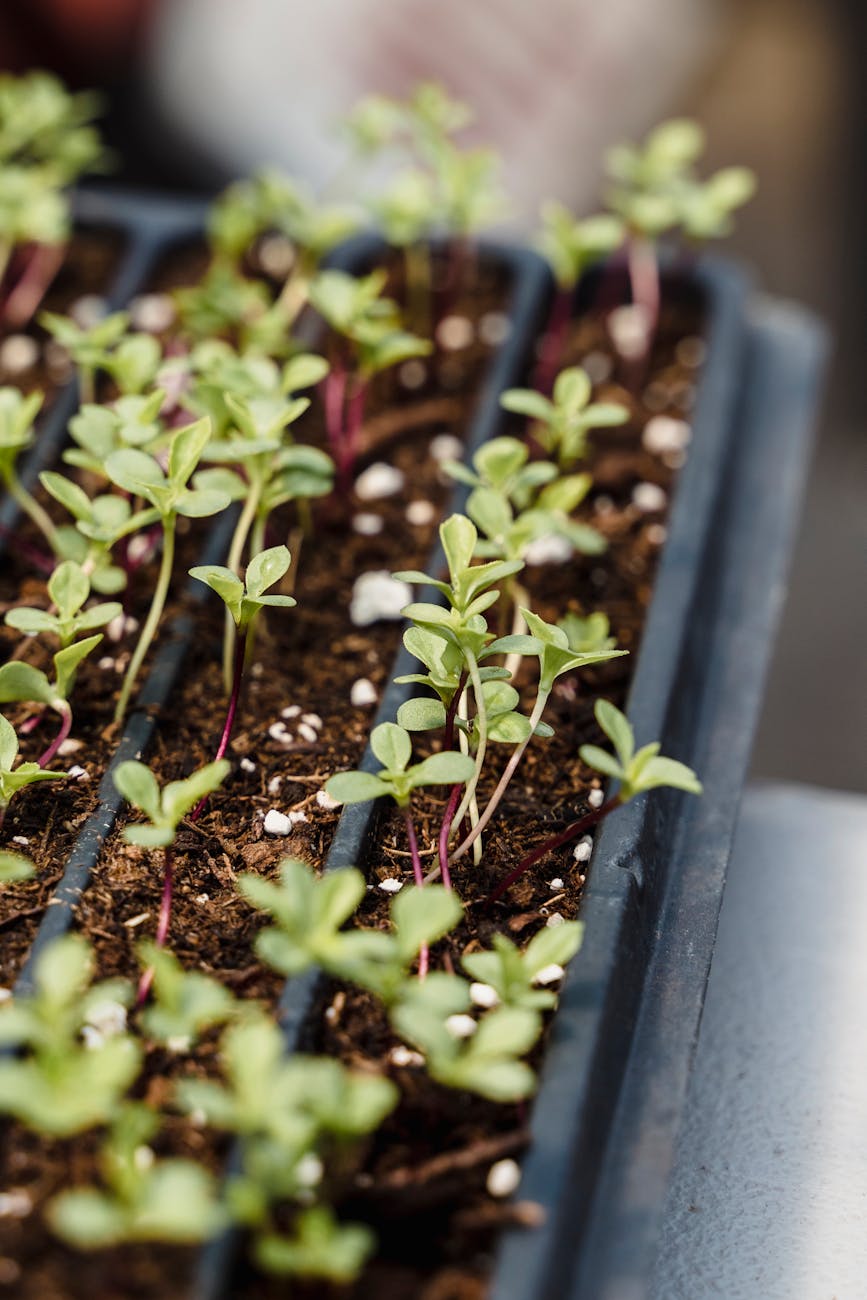
A Havana start-up grows nutritious microgreens in shipping containers, training neighbors and creating new food pathways.
🔗 Read more →


Buen Vivir princples: Food sovereignty, endogenous innovation, holistic wellbeing.
Why it matters: In crisis, communities can seed local resilience — nutritious food, livelihoods, dignity.

Photo by Greta Hoffman on Pexels.com

3. April Salumei Rainforest Conservation (Papua New Guinea)

An innovative new five-year Sustainable Development Plan for the April Salumei Rainforest Community Conservation Project in Papua New Guinea has been developed to provide long-term community benefits. 600,000 hectares of rainforest preserved by landowner-driven conservation and sustainable development planning.
🔗 Read more →

Buen Vivir principles: Holistic rights, ecological reciprocity, plural context.
Why it matters: Avoids 22.8 million tonnes of CO₂, preserves habitat, and strengthens community voice in global climate finance.

Photo by Alex Konehe on Pexels.com

4. Indigenous Fire Stewardship Revives Country (Australia)

First Nations fire practices are reviving habitats, reducing catastrophic bushfires, and strengthening cultural ties to land.
🔗 Read more →

Buen Vivir : Knowledge sovereignty, harmony with nature, collectivewellbeing
Why it matters: Indigenous fire practice reduces catastrophic bushfire risk, restores biodiversity, and reconnects people with Country.

Photo by Buu011fra u00d6zcan on Pexels.com

5. Songkhla Lake Mangrove Revival (Thailand)

Local communities restore 50 hectares of mangroves, forming a Mangrove Rehabilitation Club to sustain long-term care.
🔗 Read more →

Buen Vivir: Community-driven, participation, reciprocity with ecosystems, shared wellbeing.
Why it matters: Restored mangroves stabilize coastlines, nurture fish nurseries, and empower communities to govern local ecosystems.

Mangroves along the wateru2019s edge, shallow water offshore. by Sithara Koramparambil is licensed under CC-CC0 1.0

Paris 2024 Olympics: Transformative Sustainability or Greenwashing Controversy?

The Paris 2024 Olympic Games aimed to be the greenest ever, hosting a summit to accelerate sport’s contribution to sustainable development goals by reducing emissions and implementing carbon mitigation projects. Critics labeled the event a “greenwashing nightmare,” citing vague methods and limited accountability. Despite challenges, the event’s focus on pre-game carbon mitigation represents a significant paradigm shift for major sporting events globally.

Changing the Paradigm of Major Sports Events

The Paris 2024 Olympic Games promised to be the greenest in history. On the Eve of the games, French President Emmanual Macron and the French Development Agency hosted the first Sport for Sustainable Development Summit, which gathered Heads of State, the International Olympic Committee, and the World Health Organization to accelerate the contribution of sport to the United Nations’ Sustainable Development Goals (SDGs) by 2030.

The Olympic Games is one of the largest, most logistically complex global events. Host countries spend billions on new infrastructure, stadiums, athlete accommodation, Olympics venues, and upgrading transport. It is a mammoth undertaking, but it is also carbon intensive. Since Paris started planning for this year’s games in 2017, Paris 2024 aimed to be a game changer in the way that sports approaches its climate impacts.

The aim was to halve the emissions of this year’s games compared to the average of London 2012 and Rio 2016. There were two main goals: to reduce Games-related emissions and support carbon mitigation and capture projects. The former was the most significant. The organising committee pulled out all stops to comprehensively control and assess the entire carbon ecosystem of the event with both direct and indirect scope 1, 2, and 3 emissions from the carbon footprint from athletes and biodiversity impacts, to infrastructure, catering, waste, and even spectator travel.

The organising committee included a world-first Ecological Transformation Committee, setup to control, reduce, and reassess its carbon emissions throughout the run-up to the Games. The Ecological Transformation Committee was chaired by Gilles Boeuf and included nine experts across the areas of carbon impact, biodiversity, circular, economy, energy, catering, digital technology, temporary construction, innovation, and change management. The Committee was joined by representatives from Paris City Council, the French Ministry of Sport, the French Ministerial Delegation for the Olympic and Paralympic Games (DIJOP), the Ile-de-France Region, the Seine-Saint-Denis Department, Métropole du Grand Paris, the National Olympic and Paralympic Committees, and the French Agency for Ecological Transition (ADEME), and a representative from the Paris 2024 Athletes’ Commission. This breadth of expertise gave strength to the objectives they were trying to achieve.

Have we been greenwashed?

The pure scale of any Olympic Games dictates that it will always have a colossal effect on climate and host communities. This has led Paris 2024 to be labelled a ‘greenwashing nightmare’ by many who argue that this event is awash with vague methodology and limited accountability. There seems to be a lack of transparency and third-party monitoring in these Games that only contributes to the image of the Olympic Games being an “Olympic sustainability smokescreen”, as dubbed by Christine O’Bonsawin, an Indigenous sport scholar and member of the Abenaki Nation at Odanak in Quebec. Because of this lack of transparency, climate and sustainability watchdogs argue that we cannot verify claims that Paris 2024 is carbon-neutral or climate positive.

Researchers contend that the International Olympics Committee is one of the biggest greenwashing institutions in the world. Past attempts to assess and compensate the massive environmental and ecological impacts of the Games have been said to perpetuate “carbon colonialism”—offloading emissions through uncertain projects in the Global South that mainly service the Global North.

While I tend to agree with the transformative limitations of unclear climate accounting methodologies and stoic adhesion to market fixes, changing the status quo, especially of a dominant global event and institution such as the Olympics is impossible to achieve overnight. All change has to start somewhere, and the mindset behind such change promises a great deal for future direction.

The difference between the climate approach to the Paris 2024 Olympic Games and other previous major sporting events is that Paris 2024 sought to change the model of carbon assessment from post-games to a pre-game carbon mitigation model.  Through this model, Paris 2024 undertook a holistic vision of offsetting emissions in a major carbon impact reduction target and strategy. This paradigm shift, flipping the mitigation hierarchy to avoiding and reducing emissions first rather than a pure offset and compensation strategy is highly significant.

Throughout modern history, the neoliberal approach to climate change has been more focused on offsets and carbon markets. It is a doctrine that believes in the power of commodities over conservation and that there are limits to environmentalism within the sphere of economic growth.

This ‘ARO’ – avoid, reduce, offset (last) – approach makes it difficult to skip over the typically harder and more expensive, bottom-of-the-pyramid mitigation priorities of avoid and reduce, which can happen when relying on a post-diem assessment that leaps straight to compensation as a first tactic.

What does this mean for other major sporting events?

Major sporting events are responsible for a whopping 50 to 60 billion tonnes of tCO2e globally every year. The most logical approach to reducing the climate impact of sport is to reduce the size and scale of these events. As with the Olympics, in their current formats, these events can never be truly sustainable and will always have a large environmental impact. However, avoiding them altogether is not black and white.

Sports – both taking part and being a spectator – has a proven social and economic benefit that goes beyond socio-economic, geographic, and cultural barriers. Sporting events strengthen social networks and build a sense of belonging for participants, fostering identity and building a sense of community character and cohesion for those involved. They can stimulate economic development for disadvantaged communities and inspire social change. Conversely, they can also be the root cause of human rights violations, slavery, unbridled nationalism, and massive-scale pollution.  

To help address the entire carbon footprint of the Games, Paris 2024 declared that it developed an online tool, Climate Coach for Events for event organisers to understand and reduce the climate impact of major sporting events. This app is free for organisations to use and estimates the carbon footprint across ten categories including catering, accommodation, travel, infrastructure and energy, sports equipment, logistics, site preparation, promotional items, digital material, and waste; and provides a breakdown of the biggest source of emissions. In the same psychology of sports coaching, the app then provides a customised programme of over a hundred tangible measures that organisers can then implement in their planning to reduce their event’s carbon footprint.

Addressing climate impacts at the scale and complexity of something like the Olympics before the event demonstrates that it’s not too farfetched for other large sporting events to follow suit. Assessing the achievement of pre-emptive change rather than just rely on post-diem assessments to understand event impacts is a positive move.

Reinventing mega sporting events to realign them with international climate goals sounds like an impossible task. Of course, there is plenty more that could have always been done at the 2024 Olympics, by all – organisers, spectators, and athletes. The sheer scale of such events needs to be re-evaluated as a matter of urgency, but this event has opened pathways for thinking differently about the impacts and contributions of major sporting events, and other large events in general. Perhaps one of the greatest legacies of the Paris 2024 Olympics is that the opportunity to pioneer sustainable transformative thinking about major events proved not only possible, but even desirable.

In the ever-wise words of Nelson Mandela, “It always seems impossible until it is done”. No other thoughts resonate better with how we can address the world’s most challenging climate issues. The reinvention of future climate action in sport is on the horizon.

Read the 2024 Games sustainability reports here

The Fight for Mother Ocean


The ocean, she breathes life into the earth, into you, into me. The ocean, this ultimate vessel for the ‘Elixir of Life’ unto which we are all ultimately connected, needs us so that she may continue to sustain us. You see, this vast blue and us, we are inextricably interconnected.

The ocean covers the majority of the planet – 97 percent, in fact. The world’s four major oceans are interconnected making the vast blue at one with the earth. This vast amount of liquid water is what makes our planet unique and the primary contributor to life on Earth. Yet, we have lost respect for her and her significance, polluting 88 percent of her surface with our debris, with the vast majority of it sinking to the bottom of our precious marine ecosystems.

The ocean began her life three billion years ago and we may never fully understand the mysteries that have evolved since then. She is wise this old girl. While the earth may not look the same, her duty to birth and sustain life has remained constant.

Never one to keep still, she is always in movement. In a tangled cycle of heat and vapour, the ocean gives herself to the atmosphere and disguises herself as bright clouds that give us shade from the scorching sun, and rain that waters our crops and provides us with water to drink. The ebbs and flows of the ocean current allow life everywhere across the globe to perpetuate, to flourish and to reproduce. The sea floor is locked in a perpetual cycle of birth and destruction that shapes our earth and even influences our DNA.

The Enlightenment assumption that natural resources were simply property to be exploited is naïvely nonsensical – if we deplete and destroy nature, we ultimately damage ourselves.  Our estuaries, salt marshes, mangrove forests, coral reefs, open and deep seas all depend on an ocean thriving and in good health.

For the world’s indigenous peoples, the ocean, like all forces of nature, is a living being, and must be respected, revered, and cared for. Beliefs anchor in facts: nature sustains us, guides us, gives us life and health. The ocean provides us with food, medicine, minerals, oxygen, and freshwater.

However, today we exercise our dominion over the sea and all of her creatures and organisms, and we are paying the price.

First civilizations had a transactional relationship with the ocean, riding the seas through ancient trade routes importing and exporting knowledge, tools, spices, minerals, and other riches, and expanding empires. The seas supported our livelihoods, helping society to become what it is today. Humanity has used the ocean against itself – the very reliance civilizations had on her for expansion and progress became the driving forces that are destroying her by impacting the earth’s climate.

In modern life, the threats of climate change and human destruction have forever changed the way our ocean and her ecosystems exist and evolve. Evolution is a slow process, usually, but with our consumerist and extractive mindsets we have taken so much of the earth’s riches and given it back in waste that it has caused mass extinctions in all life forms, not least in the ocean. If we continue the way we are, in the time to come all marine life from the deepest depths to the sandy shores could suffer one of the biggest mass extinctions in the history of our planet from warming seas and changing currents.

Our polar regions are warming faster than anywhere else on Earth. The Arctic Ocean once glistened with snow and ice under a pale sun, atop with glaciers so large that humans had little knowledge of what went on in life underneath. Now plankton, scores of fish, walruses, whales and seals all are fighting to adapt to warming seas. Polar bears that completely depend on the ocean to survive are drowning, and starving with nowhere to go. It is a case of fight or perish. Through our actions though, the ocean has little say in how she changes. The ice that once gleamed in varying hues of pale blue and white protecting her from above is giving way to deep blues. As the darkest depths of the ocean reveal themselves to our polar regions, so does our future become obscure.

We humans are so intelligent that we have long studied and understood geological processes of the past, yet we are so far inept at changing the forces that will stop it from happening again. We write the history books, what is stopping us from editing them to allow for a legacy sequel?  

The ocean is the most powerful force on earth – she is a mother, a killer, a healer, and a peacemaker – lest she have the power to rest in good health. As humans we have inherited the universal right to clean water because of its importance to sustaining life. Though, some interpret that as the right to exploit at all costs, that the ocean and its supported water forms are a commodity to fulfill our needs and desires first. As a living being, she deserves agency to pursue redress if it is damaged or destroyed.

The Rights of Nature is a movement that catalyzes the connection between us and the earth. The idea of giving rights to the ocean and all water sources is to protect them against destructive and exploitative human activity – that we may live in harmony with nature and not against it. It acknowledges the inherent intimate connection we have with her, how she has helped form this planet we call home, and that she may continue to endure and sustain us with her most important work flowing through life every day. It may reorient the way we live towards our responsibilities to nature. The ocean deserves her right to be recognised and respected.

If we retrieve reverence for our ocean, we can recover respect for ourselves and our future. Honouring the reciprocal relationship we have with Mother Ocean is key to hope for times to come.  While climate change is obscuring the outlook for the future state of our planet, one thing is certain: our ocean is worth fighting for.


Good Planet News 1 June 2023

Photo by Tom Fisk on Pexels.com

If there is any time to focus on the positive it is now, with the news this week that humankind faces the double threat of extinction from climate change and AI. In that was the promise that we can still steer the course of our own fate. Some recent positive advances give hope for doing so. So, here is a roundup of the latest good environmental news.

First up is a story close to my heart. If you follow my research, you will know that my interest in Buen Vivir grew from living and working with communities in Ecuador’s Intag Valley, which have battled threats to their social and environmental wellbeing for decades. Part of the struggle was captured in my book through interviews with key people in Cotacachi County (where Intag is located). So, this victory has moved me to tears, and I hope it is the start of some positive momentum for the Rights of Nature.

  1. Rights of Nature upheld in Ecuador Court

Communities in Ecuador’s Intag Valley had a major win in March after more than 30 years of mining resistance in the region. On March 29, 2023, communities in the Intag Valley won a court case against mining companies Codelco and ENAM. The Imbabura Provincial Court ruled in favour of the Rights of Nature upheld in the Constitution since 2008 and revoked the companies’ mining licenses for the project. The win helps preserve the natural integrity of the Tropical Andes and upholds local communities’ constitutional right to consultation. The victory also expands the case law for the Rights of Nature and sets a precedent for future cases. It also demonstrates the willingness to uphold the Rights of Indigenous Peoples and rural communities in the face of extractivism demand.

2. Deforestation in the Brazilian Amazon has fallen by 68 percent

Deforestation in the Brazilian Amazon fell 68 percent in April compared to April 2022. One of President Luiz Inacio Lula da Silva presidential promises when taking office at the start of this year was to combat illegal deforestation, which rose significantly under former President Jair Bolsonaro.

3. Ecuador’s ‘debt for nature’ deal to help protect the Galápagos Islands

To Ecuador again, as the country has converted $1.6 billion (€1.5 billion) of debt into a loan to be used for conservation in the Galápagos Islands in the world’ biggest ‘debt for nature’ deal.

“The world’s biggest ocean-friendly debt swap is coming together in Ecuador to protect its unique natural resources,” says Pablo Arosemena Marriott, Minister of Economy and Finance.

4. Renewables to hit a major milestone

The renewable power sector is passing a series of important positive tipping points in 2023. Thinktank Ember’s fourth annual Global Electricity Review has found that greenhouse gas emissions from the global power sector are expected to fall for the first time because an expansion in renewable energies outstrips the growth in demand. The report analyses data from 78 countries representing 93% of global power supply. Not only that but experts predict that new solar and wind generation will become cheaper than existing fossil fuel generation.

5. Australia’s first Regenerative Food and Farming Map

Non-for-profit organisation Sustainable Table has developed Australia’s first Regenerative Food and Farming map. Regenerative agriculture helps mitigate the environmental impacts of farming and food systems. According to the Climate Council, Australian agriculture is responsible for around 13% of our greenhouse gas emissions each year. The map is a ‘first of its kind’. Taken from the website Sustainable Table state that the “map gives visibility across the industry, allows for connection and collaboration in ways never before possible, and catalyses the transformation of food and farming systems in Australia.” This also has public advantage “Connecting regenerative change makers, ethical funders and conscious humans to change Australia’s farming, food and fibre systems”. CEO of Sustainable Table Jade Miles said. “Until now there hasn’t been a national map or database of Australia’s regenerative food and farming industry…There is huge potential to learn from each other, leapfrog failures and grow the regenerative agriculture movement, and the map will play a really important role in facilitating this.” Agricultural change-makers and growers can add their businesses to the map for free by filling out the Australian Regenerative Food and Farming Map application: https://www.sustainabletable.org.au/map.

COP27 – Time to Highlight Local Climate Action

Placards, Climate Change demonstration by Julian Osley is licensed under CC-BY-SA 2.0

COP27 kicked off yesterday in Egypt, with a rockier than expected start. This climate conference has been called the “implementation COP” because of the expectation to negotiate on decisions made at Glasgow (COP26). Yet, there has already been no end of obstructions to progress.

Criticisms began with backlash against Egypt as host country because of a multitude of political scandals, including the fact that it holds approximately 60,000 political prisoners. Before the conference even started there was disappointment as civil society representatives from different African countries struggled to get passes to the events – both undermining the conference’s position as an ‘African COP’, and highlighting the eternal struggles of those most vulnerable to the effects of climate change to be included in key climate decision-making processes.

COP27 started in a less than desirable position as participating countries have failed to act on progress made at Glasgow. Only 24 countries have since updated their pledges, with Australia making the greatest strides – but that has only elevated us from ‘highly unacceptable’ to ‘unacceptable’. Just confirmed is Australia’s bid to host COP31 in 2026, but that brings up the question of legitimacy amidst a renewed focus on new fossil fuel projects.

To make matters worse, the start of the conference was delayed as delegates failed to agree on the agenda for the fortnight. One sticky point has been the inclusion of reparations for loss and damage due to climate change for the most vulnerable. One can see why, nonetheless it is crucial that those in power are held to account.

There have been calls to include a greater emphasis on adaptation in the negotiations. Given the scale of climate-related events globally over the last few years, it would be wise to strengthen community resilience and capacity to adapt.

Given all of these obstacles, there sems that there is little hope to be had in global diplomacy. This predicament powerfully emphasizes the importance of prioritising locally-led climate action and sustainability solutions. Local communities are the best placed to identify the challenges that climate change brings to them, so considering the lack of transformative capacity for global climate diplomacy to respond to the urgency of the situation, greater priority must be paid to empowering locally-identified and led solutions to the climate crisis – both adaptation and mitigation.

Community-managed projects for the conservation of biodiversity and local ecosystems, for example empowers communities to become invested in the local environments, but it also utilises vital local knowledge. Communities that are more socially invested in their environment, are more inclined to look after it and better placed to identify appropriate solutions, albeit with considerable technical and political cooperation. There are multiple substantial benefits. Not only does local climate action lead to better context-specific programs and projects, but they are also generally more equitable and lead to higher social, environmental and economic returns for a community. Locally-led solutions are usually more holistic, with fewer trade-offs between society and nature.

Grassroots projects also raise the bar of optimism on climate, which in turn leads to greater involvement and action. Given the pessimism around the expected outcomes of COP27, I will be encouraging positivity for future climate action. Every Monday I’ll be posting positive local climate news on my socials, as I firmly believe in the power of positivity to bourgeon change.

While COP27 has been led by a rocky start, it still opens up discussion and debate about what is needed at all levels as we head into this dangerous new phase of climate change. And that is cause for hope in my opinion.

Why Elon Musk Can’t End our Crises

The world’s richest man, Elon Musk, has made headlines again this week for hos $61.6 billion takeover bid for social media platform Twitter.

Political activists and media outlets have taken to declaring that his wealth would be better spent on solving world hunger and climate change. While it may be true that that money could be better spent for good, solving our global crises is not as simple as money.

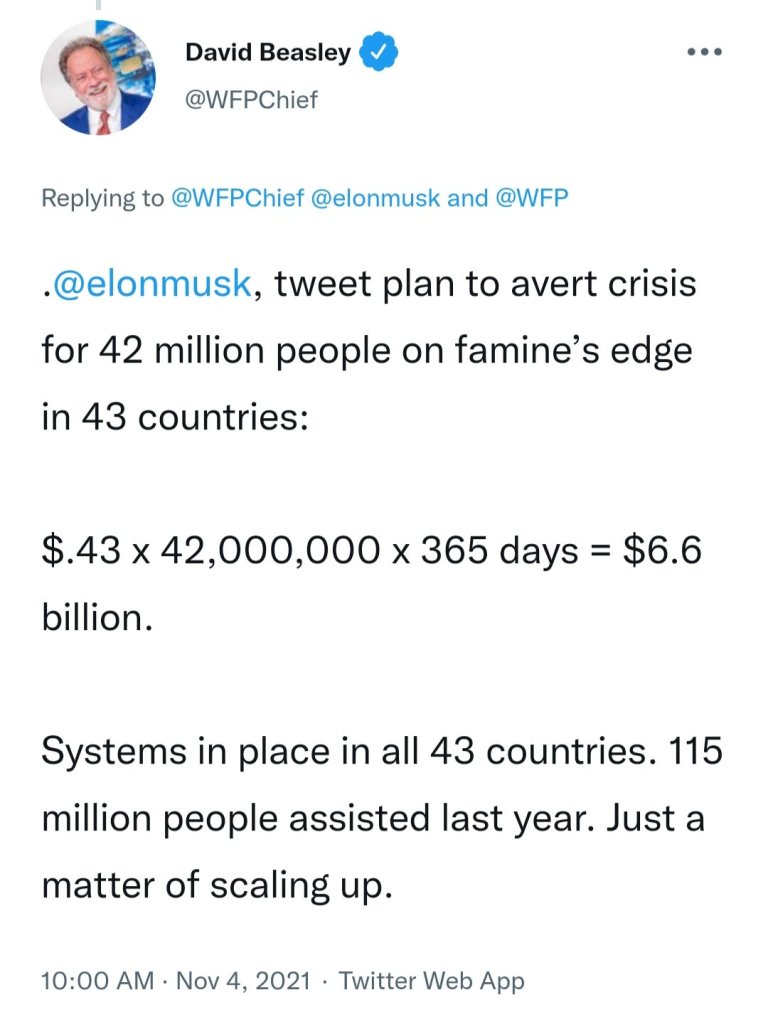
WFP estimates that up to 811 million people around the world do not have enough food, and 44 million are on the brink of famine. Last year, David Beasley, the Director of the World Food Programme challenged Musk to use his wealth to fight world hunger. A plan for $6.6b, he said, could address the food crisis for 42 million people in 43 countries by providing one meal a day. That would be a great start, but it’s more complex than that.

What institutions fail to recognize publicly when they speak of the current situation of global poverty are the historical drivers behind it. Global poverty and inequality are the result of grave historic political, economic, social and environmental failures. No amount of money will “fix” it. In fact, it is paradoxical to depend on the system that created the wealth gap and climate emergency to solve it.

Unfortunately social, economic and environmental crises are intertwined. Climate change is only making poverty worse and vice-versa. Capitalism is killing the planet and its people.

Environmental writer George Monbiot says, “you might expect an intelligent species to respond to these signals swiftly and conclusively, by radically altering its relationship with the living world. But this is not how we function. Our great intelligence, our highly evolved consciousness that once took us so far, now works against us.”

The world, our planet and its people depend on a complex web of systems- a delicate equilibrium which has been severely destabilized by global capitalism. Economic growth requires us to consume more and more, which exploits our natural resources, destroys habitats and biodiversity beyond repair. Economic crises are environmental crises.

Take the African continent alone. Extreme povery has ravaged the continent for decades. Structural poverty. Climate change has worsened the already dire situation of extreme and relative poverty because resulting devastating floods and extraordinary drought periods in recent years have led to crop failures and severe food insecurity. This will only worsen. It has been said time and time again that those most vulnerable to the effects of climate change are those who have not caused it in the first place.

Regardless of the political showdown between Musk and those who believe he should spend his fortunes on world hunger. The same economic system that leads to the creation of millionaires, billionaires and trillionaires is the same system that is at the very root of our global economic and social crises.

There is no doubt that $6b could address problems of world hunger in the here and now by providing immediate assistance to those who need it. Yet, solving world hunger, poverty and the climate crisis are going to take more than just economic investments. The root structural and systemic causes first need to be acknowledged, regretted, and changed.

I’ll leave you with the words of Monbiot, “more important than the direct impacts of the ultra-wealthy is the political and cultural power with which they block effective change. Their cultural power relies on a hypnotising fairytale. Capitalism persuades us that we are all temporarily embarrassed millionaires. This is why we tolerate it. In reality, some people are extremely rich because others are extremely poor: massive wealth depends on exploitation.”

Transformation for Climate: but, of what?

The latest warnings from the IPCC predict that the world is heading towards critical temperature limits. We have already reached 1.0 degree of global warming. The IPCC report estimates that global warming is likely to triple to 3.2 degrees unless urgent, radical action is taken immediately. The IPCC warns that incremental change is no longer enough, and what we need now is transformation. But, what does this mean?

The IPCC defines ‘transformation’ as, “a change in the fundamental attributes of natural and human systems.” Is this enough to prevent it from becoming another catchphrase amenable to co-optation as the status quo sees fit?  To avoid perpetuating what UN Secretary-General Antonio Guterres calls, “a litany of broken climate promises” the course will have to change. We are running out of options.

Transformation, therefore, should effectively address and change the structural and systemic causes of social and environmental injustices that impede any genuine change. Confronting the crisis requires urgent political and societal change.

Transformation then is not only about technology and energy policy, but also a holistic approach to how we govern society on an interwoven planet. So, when we talk about transformation, we also have to talk about what type of transformation, who is involved, how, and at what scale.

The type of transformation that can see us through the change we need is plural, locally embedded, embraces all forms of knowledge (not only technological), and is inclusive of all geographic, cultural, socio-economic, developmental, and linguistic realities. It also needs to transform behaviours and practices from a largely anthropocentric model of society to a more holistic view that embraces a human society interwoven in harmony with nature.

To speak in metaphors of interwoven systems, humans have long viewed the world like a double helix, one strand representing nature as a living being, necessary for life, and the other strand representing society seeking to dominate nature and control it. The two strands coil around each other but running in opposite directions, their purpose intertwined, yet never touching. Yet, nature and society are more like an intricately woven tapestry. One loose thread in one part, can see the rest come completely undone. We are part of nature and any attempts at transformation to save it from climate change must recognise this.

Transformation is more than about scientific and technological mitigation strategies. Part of this is shifting mentalities firmly towards a post-extractive economy, not only discussing transition. The transition to just climate policies is important, we have to get it right, but merely focusing on discussions of what it looks like takes away from the immediate radical change that is needed and the larger goal of what comes after. Continual discussion about transitions without immediate action only sustains current convictions, planted in short-term fixes.

A hybrid approach that incorporates daily social transformation with the ultimate vision of what needs to be achieved to limit global warming will help achieve both long and short-term goals. In the quest for daily transformation, education plays a major role. That is, education on all levels, formal, in the home, in communities, and in policy. Education must be strategic not to continue the messages of the past. The transformation of education thus must also be systemic. I will discuss the transformation of education in my next post.

Post-Extractive Circular Society

The theme of Earth Day yesterday was “Invest in our Planet”. The question needs to be asked, at which point does the fix-all economic narrative become redundant? While we do need future investment in new technologies, we can no longer hide behind the rhetoric of techno-fixes for reducing the amount of carbon in the atmosphere. Yes, technology and will play a crucial role in transformation, but relying on it to achieve the real physical change that is needed in urgency is not the solution. Perpetuating the myth that we can build our way out of this through technology that supports exponential economic growth is dangerously digging us a deeper grave.

The IPCC report states that other mitigation strategies are likely to be prohibitively expensive, and that is the excuse used in ideological stances to abandon any kind of concrete change. According to Munich Re Research, in 2020, climate change disasters have led to estimated global economic losses of A$272 billion. Yet, when we look at the costs of inaction the argument mounts that it may very well be more economically expensive to continue down the same path of slow transition and economic justification, but more than that it will also cost us much more than money, it will and is starting to cost lives. In 2020, there were approximately 31 million internally displaced people from climate change impacts alone. By 2050, think tank IEP estimates that at least 1.2 billion people could be displaced by climate-related events. We can therefore legitimately argue that there is more at stake than economic growth.

A move to a low carbon society will not be effective at its aims if it destabilises ecosystems and puts efforts to protect biodiversity in jeopardy. This is why transformation must not only be about the types of energy we transition to, but also how much and on what scale. For true transformation, the use of renewable resources has to be in harmony with nature, as well a society. After all, even renewal resources perpetuate an extractive mentality on a large-scale as part of a neoliberal economic growth strategy. Our global economic model, for starters, has to evolve and transform with the challenges that lie ahead.

The ways we transform the energy sector should also be plural, locally embedded, and embrace all forms of knowledge to sustain transformation in harmony with nature. Policy strategies like moving towards a circular economy, which embed multiple approaches with the same aims such as Donut Economics, Buen Vivir, Regeneration, or even Degrowth can be part of a just economic transformation towards a post-extractive society. Instead of thinking about it as only economic as we do with a circular economy, by embracing these various approaches in tandem, we can then evolve towards a circular society – renewing and regenerating all life in harmony with the natural environment.

The UN calls for “transformation [that] requires attacking the root causes that generate and reproduce economic, social, political and environmental problems and inequalities, not merely their symptoms” but there is no concrete blueprint for this type of transformation. Many scholars have argued that this requires visioning a post-extractive society that focuses on regenerative approaches to society and natural resource management.

In regeneration, it’s important to look beyond fossil fuels and carbon emissions because of the circular effects of environmental destruction. Here, the models and frameworks I mentioned earlier work within a regenerative, circular society, such as Donut Economics, Buen Vivir, and Degrowth, for example. For future actions that are compatible with nature, so that the environment may regenerate and flourish, incorporating the rights of nature into future global and national climate policies would be beneficial.

Regenerative alternatives to development promote a state where human society and nature live in harmony. Regenerative approaches are not just about reaching Net Zero, but they are holistic and integral in that they seek to leave environments and their societies in a better state, having a positive impact on human wellbeing and the environment as a whole. 

So, in summary, when we think about the type and scale of change needed to tackle the environmental challenges that lie ahead, transformation must be plural, locally embedded, and embrace all forms of knowledge, particularly Indigenous knowledges. It is regenerative, seeking structural and systemic change which includes, as a foundation, formal and informal education systems. Transformative regenerative approaches work in harmony with nature and seek to enhance environmental wellbeing, as well as societal wellbeing. Transformation then, upends the way the world currently works, towards a more socially and environmentally sustainable future, not solely towards better economic growth.

Twosday is the day to start living in harmony with nature

Today Tuesday, 22nd day of the 2nd month in 2022 is Twosday: 22.2.2022.

Whether you are spiritually inclined or not, the repetition of numbers is bound to pop out at you. Today’s date in particular has become a source of existential inquiry It has many people wondering what the greater signification of the day is and what its future consequences may be, evoking something metaphysical in our curiosities.

Numerology or the study of number symbolism can be traced back to Ancient Greece in 500BC when philosopher and mathematician Pythagoras developed a theory between numbers and their association with musical notes, which then became symbolic of individual’s personalities by tracing their birthdates. Numerology has since taken on many forms from biblical, philosophical, and cultural.

To numerologists, the number 2 symbolises harmony and cooperation, the union of basic dualities in nature. Its biblical signification brings about the unification of two forces.

Scientists have said that there is no scientific basis in the theory of today’s date. But at the very least it is culturally rooted in the aspiration to create shared meaning. Of course, I’m going to put an environmental spin on this.

For most of modern history, human societies have created a duality between the natural and human worlds, which has arguably been at the root of much of our demise – both social and environmental. This separation of worlds has been demonstrated to be one of the primary causes of climate change, as humans seek to exploit natural resources.

There has been much work coming from scholarly research and practitioners about the need to end this divide and seek harmony and cooperation between nature and society so that we may really transform the future trajectory of the planet.

So let me plant this seed…

What if today 2.22.2022, the day associated with change, harmony, unification is the day we individually and communally change the dualist way we look at the world and understand that if we, as humans live in harmony with nature, it might have significant transformative and positive impacts on our world and climate? Whether you believe in the power of numbers or not, our dualism has to change, so why not start with today?

According to numerologists, by taking the root numbers of 2.22.2022 today’s date is associated with the “destiny number” 3, which signifies optimism. If nothing else, today can be associated with the day we changed the human-nature duality of modern-day society and started thinking about both the human and natural environments as one union. And that, if we think about long-term impacts on climate change, is much cause for optimism!

Sustaining Water Wellbeing

Our blue planet is a testament to the integral role of water to every living being on earth. Access to water not only satisfies our basic needs but our psychological needs too.

Over the summer I may have been a little quiet as I took time with my family. A large part of wellbeing is taking time to connect with our families, and ourselves and for me, the school holiday period is a good time to do that. We spent a lot of time being by the water, whether that be the ocean or the rivulet. The ambiance of water – blue space – has therapeutic effects on human health and wellbeing. The time spent by water was a timely reminder that we are connected to the liquid stuff in more ways than we realise.

Our blue planet is a testament to the integral role of water to every living being on earth. Access to water not only satisfies our basic needs but our psychological needs too. Our need for water can be categorised by Manfreed Max-Neef’s nine axiological needs for Human-Scale Development, that is: subsistence, protection, participation, identity, idleness, creation, and even affection, understanding and freedom; but which also corresponds to Maslow’s psychological needs mirrored in his Hierarchy of Needs such as the need for leisure time, culture and community. Oftentimes, water is only equated to the need for subsistence or survival.

Water is a communal concept. The only thing individual about water is the way its presence makes us feel, subjectively. Yet, even that has objective consequences because, numerous studies show that being connected to nature, particularly water, makes people feel part of something bigger than themselves, imparting a feeling of awe and transcendence. This feeling of being connected to something bigger helps develop the responsibility to protect the environment around us.

Given the overwhelming importance of water to life on earth, the principle of reciprocity is especially crucial. In other words, being cognizant of the society-nature continuum and conscious of the fact that what we take, we must also give back. The Socio-Eco Wellbeing that results from Buen Vivir, confirms transcendent values like our deep connection to water, highlighting the importance not only of human wellbeing but also environmental wellbeing.

The United Nations resolution 64/292 calling for access to safe water to be considered as a human right was passed in 2010 with the support of 122 countries. It states that “the human right to water entitles everyone to sufficient, safe, acceptable, physically accessible and affordable water for personal and domestic uses.” (UN CESC – General Comment 15, paragraph 2).

Although no one can deny the necessity of water as human, and the need for everyone, everywhere to be able to access clean, safe water, it has been argued that making it a human right only reinforces the mentality of human’s dominance over nature – that we must control it as a means to ensuring our own survival and livelihood, cementing if you like, the idea of water being a commodity. It should not be.  Rather, it should be understood as an essential part of the earth’s lifecycle, of which we are also a part.

Our modern-day commodity-like dependence on water leads to pollution, drought, water scarcity, and consequently diseases and food insecurity. Notwithstanding our absolute need for clean, fresh water; shifting mindsets from water as a human right to the responsibility of humans to ensure the health and sustainability of water sources can help ensure the former. Of course, this would not be equitable without re-examining the structural causes as to why many communities go without safe drinking water, and sacred water environments destroyed, polluted, or even seized.

In neoliberal development, human rights and environmental protection are often in conflict with each other. In 2010, the United Nations Human Rights Council affirmed that the human right to water is legally binding upon states. To guarantee water as a human right means first addressing the structural and systemic road bumps that see the misuse, overuse, and exploitation of water and water sources. A large part of this is due to industry consumption. Particularly in communities in the Global South which have had multinationals and/or governments misuse and pollute local water sources for production’s sake. Watercourses are protected internationally by the “no-harm” principle in international law. That may help with seeking reparations,  but there is nothing concrete to prevent harm being done in the first place.

Harms to water sources create water stress, not only for humans but also for all living ecosystems that rely upon water for survival. The consequences are dire and cyclical. It affects food systems, livelihoods, even reactional activities. In short, it affects both human and ecological wellbeing and threatens our ability to satisfy both basic and psychological needs.

So, let’s put a spin on this. If we viewed water not as a right, but as a guarantor of both human and ecological wellbeing that must be protected and cared for to be utilized, would that change anything? Should it then not just be a question of society’s needs, but environmental ones too? The first step might be to also ask: what does water need to ensure its continual and safe replenishment?

Personifying ecological resources, for example, is a practice and worldview taken by Indigenous Peoples for generations, and it may help better ensure sustainability by changing the way we look at our natural resources. This practice has been ratified in law in a handful of cases where local jurisdictions uphold the Rights of the Nature, such as the constitutional amendments in Ecuador which recognise such rights, or the treaty ratified in New Zealand with the Māori iwi recognising the Whanganui River as a legal entity.

Complementing the right of water should therefore be the application of environmental personhood – providing water itself rights to exist and survive in good health. These two ideas need to harmonize each other because, without water, there is no life – human or otherwise. On the contrary, without humans, water will continue to flow and perhaps thrive, without the threats of overuse and pollution. Unfortunately, we humans cannot say the same about water.

Path to and beyond COP26 : why it’s important and what needs to happen Pt III

Photo by Riya Kumari on Pexels.com

Time to change the economic system


We are in a critical climate moment. As discussed in parts I and II of this post we know that we need transformative change. We know we need all actors to play a pivotal role. We know that we need to prioritize knowledge and voices of Indigenous peoples and traditional groups, who have a deep and inherent connection to the earth. We also know that we need political buy-in and multilateral commitments for a crisis that knows no geographical boundaries. Most of all, we know that we need wholesale systemic change – social, political, and economic. Let’s discuss that last point.


As Naomi Klein puts it in her book ‘On Fire’, “debates about climate action remain trapped in a paradigm that equates quality of life with personal prosperity and wealth accumulation.” We know, however, (and by we, I am referring to not just you and I, but politicians from all ideological perspectives, as well as economists and academics) that this perverse view of economics is no longer attainable, sustainable nor desirable. As the number of rich shrink, while simultaneously growing their wealth by billions, the vast mass of people living in poverty snowballs. The current global economic system exploits the planet and its resources for the benefit of very few, while those most disadvantaged will be the worst impacted by climate change.


Klein argues that in this respect “there is much to learn from Indigenous-led movements” like Buen Vivir, which she describes as a “focus on the right to a good life as opposed to the more-and-more life of ever-escalating consumption and planned obsolescence.”


Phasing out coal, moving away from extractive policies including fossil fuels and biofuels, moving towards a needs-based approach to resource consumption, towards renewables with an emphasis on community-based and small-scale renewable energy transitions will need to be part of the solution. Moving away from fossil fuels is the bare minimum, but it is not the magic bullet to save the planet from destruction. We need to do more. It is not good enough to replace one form of large-scale extraction (fossil fuels) with another just because it is the easier option the lesser of two evils. Non-fossil fuel extraction and exploitation also has negative, irreversible impacts on the planet’s carrying capacity, if not in the short term, in generations to come. Deforestation one major extractive activity but there are others. So effective solutions start with transforming the global economic model.


Major key adjustments need to be made to the global economic system, and national economies and development policies can begin to immediately reflect a wholescale commitment to striving for rapid and radical emissions reductions, and aiming for Net Zero by 2030. The UN says that countries will have to commit to at least 45 percent emissions reductions by 2030 if we are to have any chance of limiting global warming to 1.5 degrees. Climate Council of Australia argues that this will need to be more like a 75 percent reduction by 2030, with Net Zero by 2035 based on current risk assessments. However, a new assessment conducted by Breakthrough, the National Centre for Climate Restoration argues that there is no carbon budget for 2030 as we are already overdrawn and that based on past emissions we are already on track to reach 1.5 degrees by 2030. Net Zero by 2050 is too late, yet loose ‘targets’ made by countries like Australia are locking us into climate catastrophe.


Released in a briefing paper earlier this year, Breakthrough argues that we will need to reach Net Zero by 2030 to keep warming below 2 degrees, a fact that has been argued by many climate scientists and advocates including Greta Thunberg. It states, “The world needs to be at zero emissions by 2030 for the 2°C target, based on three assumptions: 1. Mitigation expenditure no more than 3% of GDP; 2. No geoengineering; 3. Climate sensitivity is not low (Lamontagne et al, 2019. Nature Climate Change, 9:290–294).”

Whatever the commitment, to reach Net Zero we need a complete transformation of the global economic system. The CSIRO says, “Reaching Net Zero will require a fundamental reimagining of everything we do. It will require a new energy system, new modes of transport, new fuels, new materials, new modes of financing investments, new ways for industry sectors to interact and new ways of living on a scale – and at a pace we have never come close to achieving before.” But it’s not enough to assume that we can technologically innovate our way out of this. We also need a reimagining of society to transform the way, scale and speed at which we consume. To quote journalist Sarah O’Connor,


“To this new world, let’s not go back to a past that wasn’t working anyway !”


The global capitalist system that rewards competition and the exploitation of nature for the accumulation of individual wealth can no longer be logically and ethically argued as best system for an economy bounded by social injustices and planetary restraints.


In the near future, greater, more radical changes to the global economic system will need to be made. There are many proposals that policymakers and economists can consider, for example: degrowth, the social and solidarity economy, regenerative economy, and a circular society (which not only incorporates a circular economy, but also social and environmental factors including knowledge that impinge just outcomes).

It may be that no one single alternative model will be appropriate to transition markets to Net Zero, instead, key elements of the various significant models can be incorporated into one cohesive response that can be tailored to different contexts, so as not to reinforce the economic growth approach, but to level global equity, respond to fundamental needs and eliminate extreme poverty. With the last factor, it is instrumental to evaluate multidimensional poverty (environmental, wellbeing, social cohesion, health, education, sanitation, etc), not just economic poverty.

The path to Net Zero is not a linear one. It involves all actors – civil, governmental, business and organisations -and it requires rapid, radical systemic change to transform society, industry and politics in a just manner.