Good Planet News 2025 Wrap-Up

Photo by Arthur Ogleznev on Pexels.com

It’s easy to get caught up in the world that was in 2025. This year has been fraught with catastrophe, war, climate disaster, and conflict. It’s even more important now to reflect on the positive developments for our planet and our communities in the past 12 months. This 2025 wrap-up doesn’t bring you individual news stories, but several round-ups of good planet news stories for 2025.

1) Conservation Wins: WWF Highlights Global Progress

What happened: A year-end review from WWF highlights major conservation successes in forests, seas, and freshwater ecosystems. It also showcases achievements in species protection. The review demonstrates collective gains from restoration and stewardship.


Why it’s hopeful: Stories like restored habitats and species thriving offer hope that long-term conservation efforts do pay off when communities and scientists work together.

Read the full story: World Wildlife Fund


2) Positive Environmental Stories from Around the World

What happened: A curated roundup of uplifting environmental developments. This includes renewable tech innovations and remarkable biodiversity news. This proves that positive change is happening globally.


Why it’s hopeful: Seeing diverse and creative solutions and wins across sectors is encouraging. It reinforces that progress isn’t one-dimensional. People everywhere are contributing to it.

Read the full story: euronews


3) Time’s Good News of the Year

What happened: The Antarctic hole is shrinking. Green turtles have reversed their extinct status. These are some of the positive science and climate stories highlighted by Time magazine from 2025. These stories spotlight breakthroughs and nature recovery updates. They also showcase innovation that provides reasons for optimism.


Why it’s hopeful: The power of the narrative. Coverage from a major global outlet helps bring positive momentum to the mainstream narrative. This balances distressing climate coverage with tangible progress.

Read the full story: TIME


4) Science & Tech Advances for the Planet

What happened: The Week outlined key environmental and climate science breakthroughs in 2025. These included advances in carbon tracking, green materials, energy tech, and ecosystem monitoring.


Why it’s hopeful: Technical innovation supports renewable energy and ecosystem resilience. It fuels long-term solutions beyond policy alone.

Read the full story: The Week


5) Historic Clean Energy Milestone: Renewables Outpace Coal

What happened: For the first time in history, renewable energy (mainly solar and wind) produced more electricity globally than coal in 2025. This event marked a symbolic and systemic shift in the global power mix.


Why it’s a big climate story: It’s a measurable global shift in how we power the world. This change is driven by technology, markets, and massive deployment of clean energy. It signals that in the energy system where most carbon comes from, cleaner sources are now leading.
Read the full story: Reuters

Hope, Connection & Climate Progress

From biodiversity rebounds to world-wide clean energy milestones, 2025 was a year of interdependence, regeneration, and shared purpose:

Nature heals when nurtured: Conservation milestones and biodiversity gains remind us that ecosystems can rebound when humans partner with nature.

Clean technology becomes common ground: Breakthroughs and energy shifts aren’t just technical; they represent communities moving toward shared prosperity and ecological stewardship.

Hope is collective: These stories highlight that meaningful climate progress is not isolated. It emerges from scientists, activists, local organisers, engineers, and everyday people working together.

Good Planet News Weekly, 6 November

Edition: 6 November 2025
Theme: Respecting our Oceans, Restoring Balance, Regenerating Connection

Each of these stories embodies Buen Vivir: the understanding that socio-eco wellbeing arises when we live in harmony with all life. From Antarctic waters to the Amazong, people are re-imagining progress not as extraction, but as regeneration.

  1. UK Retailer Ends Krill Sales for Antarctic Conservation

Holland & Barrett, a major UK health retailer, has stopped selling krill-based supplements to protect the Southern Ocean ecosystem. The move supports marine biodiversity by reducing harvest pressure on krill — the foundation of the Antarctic food web.
Source: Sea Shepherd Global – Positive Waves October 2025

Buen Vivir connection: Recognising the rights of ocean life to flourish, not merely to serve human markets.


Why it matters: Small consumer-market shifts can ripple outward to protect critical species and foster corporate accountability grounded in ecological ethics.

2.  Wild Animals Officially Recognised as Critical Enablers of Climate Solutions

Photo by Pixabay on Pexels.com

In a landmark move last month, the International Union for Conservation of Nature (IUCN) has officially recognised wild animals as essential allies for nature-based climate solutions. Thriving populations — from whales and fish that store carbon in the ocean to elephants and birds that regenerate forests — stabilise the planet’s systems.

This resolution sparks a significant turning point in international law, reframing wildlife not just passive victims of climate change, but as active participants, through seed dispersal, nutrient cycling, and ecosystem balance.


Source: Oceanographic Magazine

Buen Vivir connection: Affirms the interdependence of all life, recognising animals as holders of rights and co-creators of planetary balance.


Why it matters: Protecting animals becomes a pathway to restoring carbon cycles, regenerating ecosystems, and renewing our relationship with Earth.

3. Community-Led Ocean Protection Through Soft Law

Photo by Nataliya Vaitkevich on Pexels.com

Researchers at the University of Exeter show that voluntary, community-based agreements can outperform rigid regulations in protecting marine ecosystems. By respecting local autonomy and cultural context, communities sustain conservation more naturally.


Source: Oceanographic Magazine

Buen Vivir connection: Harmony through collaboration, not domination.


Why it matters: Empowering coastal communities affirms that ecological wisdom lies not only in science, but in the lived experience of those most connected to the sea.

4. Brazil: Forest Protection and Local Prosperity Intertwined

Photo by Bill Salazar on Pexels.com

At the Instituto Arapyaú, Renata Piazzon and partners are demonstrating that healthy forests and thriving local economies can coexist. Their projects link sustainable production, community wellbeing, and biodiversity.


Source: Mongabay – Brazil Can Protect Its Forests While Growing Its Economy

Buen Vivir connection: Mutual flourishing of people and ecosystems.


Why it matters: It shows how care for land and nature can generate enduring socio-eco wellbeing.

5. Boulder, Colorado: Urban Food Security Through Nature-Based Solutions

Photo by Simon Berger on Pexels.com

In Boulder, community members are collaborating with local Nature-Based Solutions teams to expand urban farms, restore pollinator corridors, and build climate resilience.
Source: City of Boulder

Buen Vivir connection: Food security re-roots the idea of nourishment in place, community, and reciprocity.


Why it matters: Demonstrates how cities can regenerate ecosystems while improving food access, transforming concrete into care.

Holistic Earth Boundaries for a Safe Climate Need Systems Transformation

Photo by Cup of Couple on Pexels.com

A new study published in Nature Journal last Wednesday 31 May by the international scientist group Earth Commission created a holistic measurement framework of quantifiable boundaries for climate, air pollution, phosphorus, and nitrogen contamination of water from fertilizer overuse, groundwater supplies, fresh surface water, the unbuilt natural environment, and the overall natural and human-built environment.

The holistic measuring of the earth’s interlocking ecosystems considers not only the point at which environmental conditions become harmful for people but also the risks for each environmental element, while also considering justice on a local and regional scale. Elements of justice are important for climate change because the groups most vulnerable to climate impacts are those who have contributed least to the climate crisis.

As the authors state, “The stability and resilience of the Earth system and human well-being are inseparably linked, yet their interdependencies are generally under-recognized; consequently, they are often treated independently” – particularly at the policy level – and, “rapid changes to the Earth system undermine critical life-support systems with significant societal impacts already felt, and they could lead to triggering tipping points that irreversibly destabilize the Earth system. These changes are mostly driven by social and economic systems run on unsustainable resource extraction and consumption. Contributions to Earth system change and the consequences of its impacts vary greatly among social groups and countries. Given these interdependencies between inclusive human development and a stable and resilient Earth system (Rockström et al)”.

The Earth Safe Boundaries (ESB) proposed in the framework set out by over 40 scientists, do not represent ‘tipping points’ (although tipping points inform the ESBs), but rather set out safe scientific boundaries for “maintain[ing] and enhanc[ing] the stability and resilience of the Earth system over time, thereby safeguarding its functions and ability to support humans and all other living organisms”.

Climate justice and social justice are inextricably linked. This fact is becoming increasingly recognised on a global stage. In praxis, it requires addressing historic injustices such as colonialism, resource exploitation, and land access that have driven the climate crisis while destroying ecosystems, and livelihoods, and wiping out local economies, biodiversity, culture, and displacing communities. Systems change in local and regional scale development is an important leverage to ensure that we stay within these holistic earth boundaries and address injustices through systems change.

The study concludes that meeting the just boundaries without significant harm to humans and ecosystems requires transformation. While they provide a good tool for the measurement of the earth’s safe boundaries and the threshold for crossing those limits, they do not provide any practical suggestions for that transformation.

“Nothing less than a just global transformation across all ESBs is required to ensure human well-being. Such transformations must be systemic across energy, food, urban and other sectors, addressing the economic, technological, political and other drivers of Earth system change, and ensure access for the poor through reductions and reallocation of resource use. All evidence suggests this will not be a linear journey; it requires a leap in our understanding of how justice, economics, technology and global.”

Rockström et al

In that respect, the ESBs can be seen to complement more practical frameworks for local-level environmental and social wellbeing.

There are many alternative concepts that can empower communities at the local level to address these issues. Many are being embraced on larger scales such as regenerative economies, circular economies, and the doughnut model. In fact, the study authors state that the ESBs look to build upon policy and research on Planetary Boundaries (PBs) framework, doughnut economics, and the Sustainable Development Goals. Yet, if we take a more holistic view of these interlocking systems, it is not only economic models that should be considered but whole-of-society models.

Frameworks like Buen Vivir that seek to address social, economic, and environmental factors at the local levels by empowering local communities to act within ecological and social boundaries can be effective local solutions to the climate crisis while at the same time addressing issues of justice and wellbeing. Models that connect the whole-earth systems including social and environmental wellbeing are best placed to start achieving long-term change that is scaled up to include national and global level policies and consumer market change. They provide viable points of action that is easily implemented and correlated with policy.

In short, scientifically quantifiable boundaries are vital for the future of the planet and humankind, but these must go hand-in-hand with actionable and practical solutions that can be translated on the ground. Transformation of all systems is thus where we must start to ensure that we approach the safe and just boundaries with caution for the future stability and resistance of earth’s interconnected systems.

Good Planet News 1 June 2023

Photo by Tom Fisk on Pexels.com

If there is any time to focus on the positive it is now, with the news this week that humankind faces the double threat of extinction from climate change and AI. In that was the promise that we can still steer the course of our own fate. Some recent positive advances give hope for doing so. So, here is a roundup of the latest good environmental news.

First up is a story close to my heart. If you follow my research, you will know that my interest in Buen Vivir grew from living and working with communities in Ecuador’s Intag Valley, which have battled threats to their social and environmental wellbeing for decades. Part of the struggle was captured in my book through interviews with key people in Cotacachi County (where Intag is located). So, this victory has moved me to tears, and I hope it is the start of some positive momentum for the Rights of Nature.

  1. Rights of Nature upheld in Ecuador Court

Communities in Ecuador’s Intag Valley had a major win in March after more than 30 years of mining resistance in the region. On March 29, 2023, communities in the Intag Valley won a court case against mining companies Codelco and ENAM. The Imbabura Provincial Court ruled in favour of the Rights of Nature upheld in the Constitution since 2008 and revoked the companies’ mining licenses for the project. The win helps preserve the natural integrity of the Tropical Andes and upholds local communities’ constitutional right to consultation. The victory also expands the case law for the Rights of Nature and sets a precedent for future cases. It also demonstrates the willingness to uphold the Rights of Indigenous Peoples and rural communities in the face of extractivism demand.

2. Deforestation in the Brazilian Amazon has fallen by 68 percent

Deforestation in the Brazilian Amazon fell 68 percent in April compared to April 2022. One of President Luiz Inacio Lula da Silva presidential promises when taking office at the start of this year was to combat illegal deforestation, which rose significantly under former President Jair Bolsonaro.

3. Ecuador’s ‘debt for nature’ deal to help protect the Galápagos Islands

To Ecuador again, as the country has converted $1.6 billion (€1.5 billion) of debt into a loan to be used for conservation in the Galápagos Islands in the world’ biggest ‘debt for nature’ deal.

“The world’s biggest ocean-friendly debt swap is coming together in Ecuador to protect its unique natural resources,” says Pablo Arosemena Marriott, Minister of Economy and Finance.

4. Renewables to hit a major milestone

The renewable power sector is passing a series of important positive tipping points in 2023. Thinktank Ember’s fourth annual Global Electricity Review has found that greenhouse gas emissions from the global power sector are expected to fall for the first time because an expansion in renewable energies outstrips the growth in demand. The report analyses data from 78 countries representing 93% of global power supply. Not only that but experts predict that new solar and wind generation will become cheaper than existing fossil fuel generation.

5. Australia’s first Regenerative Food and Farming Map

Non-for-profit organisation Sustainable Table has developed Australia’s first Regenerative Food and Farming map. Regenerative agriculture helps mitigate the environmental impacts of farming and food systems. According to the Climate Council, Australian agriculture is responsible for around 13% of our greenhouse gas emissions each year. The map is a ‘first of its kind’. Taken from the website Sustainable Table state that the “map gives visibility across the industry, allows for connection and collaboration in ways never before possible, and catalyses the transformation of food and farming systems in Australia.” This also has public advantage “Connecting regenerative change makers, ethical funders and conscious humans to change Australia’s farming, food and fibre systems”. CEO of Sustainable Table Jade Miles said. “Until now there hasn’t been a national map or database of Australia’s regenerative food and farming industry…There is huge potential to learn from each other, leapfrog failures and grow the regenerative agriculture movement, and the map will play a really important role in facilitating this.” Agricultural change-makers and growers can add their businesses to the map for free by filling out the Australian Regenerative Food and Farming Map application: https://www.sustainabletable.org.au/map.

COP27 – Systems Change for Climate Action

On day 2 of the COP27, session 3: High-level Session on Systems Change and Climate and Sustainability Innovations examined the deep paradigm shift needed for effective climate action. There was one key overarching message that I took from this session that also resonated with my own work: we need a radical rethink of our economic systems, social justice, and the way we approach natural resources.

There were two issues that panelists argued need addressing in terms of innovation if we are to address climate change effectively and timely: 1) decoupling human wellbeing from the use of natural resources; 2) power, or rather the decentralization of power. Both issues are addressed in a Buen Vivir framework, which is one reason why I focus on the concept, not only for social wellbeing but ecological wellbeing too. It ties into yesterday’s discussion on empowering local communities for climate action.

Janez Potocnik, Co-Chair of UN International Resource Panel hit the nail on the head when he argued that we need to move from an economy that sees humans as external to nature, to one which understands humans are a part of nature. He also stated that we need to remove the causes which lead to negative impacts, of which extractivism is a core function because it is a driver of human needs, but it is also the cause of great inequalities.

Janez argued that to live sustainably, we must move to provisioning for human needs, rather than servicing existing paradigms. I argue further that in that, we must also provision for environmental needs. Without taking into consideration the needs natural resources, ecosystems and biodiversity have to continue to function and thrive, we risk destroying them to the detriment of society.

Dr Andres Steer, President of Bezos Earth Fund brought up the critical issue of power and control – that in the absence of empowering local communities to take action on the ground, any advances in innovation (whether that be technological, knowledge, economic, or otherwise) are void. This is perhaps one of the greatest challenges to effective climate action, the ability for decision and policy-makers, and others who hold the balance of power to cede some of that power to local communities to identify and implement solutions.

We see this with the concept of neoliberal development, under which the idea of sustainable development – and multilateral policymaking forums – sit. The overarching paradigm sees one set of values as dominant and therefore urges everyone to take the same approach, without having any idea about local challenges and the context on the ground. Dr Steer urged the UN to consider this transformative climate action, pleading, “as we think about changing the system, let’s not forget that on Monday morning we need to address real problems on the ground.” In other words, high-level aspirational commitments are nice, “and make for good dinner party conversation”, but are not always conducive to feeding effective solutions in real-time.

In closing this session, the facilitator summarised that “we have called for radical rethink. We have called for accepting that we will have to act in crisis. We are not going to be dealing with a world that is not in crisis.”

On that note, it is reassuring to hear the acknowledgment that frameworks and concepts like Buen Vivir, Donut Economics, Degrowth, Circular Society, and others that were once considered too ‘radical’ and pie-in-the-sky, could bring the kinds of holistic empowerment solutions the world needs in times of urgent climate crisis. Now it is about taking these from idea to action.

Transformation for Climate: but, of what?

The latest warnings from the IPCC predict that the world is heading towards critical temperature limits. We have already reached 1.0 degree of global warming. The IPCC report estimates that global warming is likely to triple to 3.2 degrees unless urgent, radical action is taken immediately. The IPCC warns that incremental change is no longer enough, and what we need now is transformation. But, what does this mean?

The IPCC defines ‘transformation’ as, “a change in the fundamental attributes of natural and human systems.” Is this enough to prevent it from becoming another catchphrase amenable to co-optation as the status quo sees fit?  To avoid perpetuating what UN Secretary-General Antonio Guterres calls, “a litany of broken climate promises” the course will have to change. We are running out of options.

Transformation, therefore, should effectively address and change the structural and systemic causes of social and environmental injustices that impede any genuine change. Confronting the crisis requires urgent political and societal change.

Transformation then is not only about technology and energy policy, but also a holistic approach to how we govern society on an interwoven planet. So, when we talk about transformation, we also have to talk about what type of transformation, who is involved, how, and at what scale.

The type of transformation that can see us through the change we need is plural, locally embedded, embraces all forms of knowledge (not only technological), and is inclusive of all geographic, cultural, socio-economic, developmental, and linguistic realities. It also needs to transform behaviours and practices from a largely anthropocentric model of society to a more holistic view that embraces a human society interwoven in harmony with nature.

To speak in metaphors of interwoven systems, humans have long viewed the world like a double helix, one strand representing nature as a living being, necessary for life, and the other strand representing society seeking to dominate nature and control it. The two strands coil around each other but running in opposite directions, their purpose intertwined, yet never touching. Yet, nature and society are more like an intricately woven tapestry. One loose thread in one part, can see the rest come completely undone. We are part of nature and any attempts at transformation to save it from climate change must recognise this.

Transformation is more than about scientific and technological mitigation strategies. Part of this is shifting mentalities firmly towards a post-extractive economy, not only discussing transition. The transition to just climate policies is important, we have to get it right, but merely focusing on discussions of what it looks like takes away from the immediate radical change that is needed and the larger goal of what comes after. Continual discussion about transitions without immediate action only sustains current convictions, planted in short-term fixes.

A hybrid approach that incorporates daily social transformation with the ultimate vision of what needs to be achieved to limit global warming will help achieve both long and short-term goals. In the quest for daily transformation, education plays a major role. That is, education on all levels, formal, in the home, in communities, and in policy. Education must be strategic not to continue the messages of the past. The transformation of education thus must also be systemic. I will discuss the transformation of education in my next post.

Post-Extractive Circular Society

The theme of Earth Day yesterday was “Invest in our Planet”. The question needs to be asked, at which point does the fix-all economic narrative become redundant? While we do need future investment in new technologies, we can no longer hide behind the rhetoric of techno-fixes for reducing the amount of carbon in the atmosphere. Yes, technology and will play a crucial role in transformation, but relying on it to achieve the real physical change that is needed in urgency is not the solution. Perpetuating the myth that we can build our way out of this through technology that supports exponential economic growth is dangerously digging us a deeper grave.

The IPCC report states that other mitigation strategies are likely to be prohibitively expensive, and that is the excuse used in ideological stances to abandon any kind of concrete change. According to Munich Re Research, in 2020, climate change disasters have led to estimated global economic losses of A$272 billion. Yet, when we look at the costs of inaction the argument mounts that it may very well be more economically expensive to continue down the same path of slow transition and economic justification, but more than that it will also cost us much more than money, it will and is starting to cost lives. In 2020, there were approximately 31 million internally displaced people from climate change impacts alone. By 2050, think tank IEP estimates that at least 1.2 billion people could be displaced by climate-related events. We can therefore legitimately argue that there is more at stake than economic growth.

A move to a low carbon society will not be effective at its aims if it destabilises ecosystems and puts efforts to protect biodiversity in jeopardy. This is why transformation must not only be about the types of energy we transition to, but also how much and on what scale. For true transformation, the use of renewable resources has to be in harmony with nature, as well a society. After all, even renewal resources perpetuate an extractive mentality on a large-scale as part of a neoliberal economic growth strategy. Our global economic model, for starters, has to evolve and transform with the challenges that lie ahead.

The ways we transform the energy sector should also be plural, locally embedded, and embrace all forms of knowledge to sustain transformation in harmony with nature. Policy strategies like moving towards a circular economy, which embed multiple approaches with the same aims such as Donut Economics, Buen Vivir, Regeneration, or even Degrowth can be part of a just economic transformation towards a post-extractive society. Instead of thinking about it as only economic as we do with a circular economy, by embracing these various approaches in tandem, we can then evolve towards a circular society – renewing and regenerating all life in harmony with the natural environment.

The UN calls for “transformation [that] requires attacking the root causes that generate and reproduce economic, social, political and environmental problems and inequalities, not merely their symptoms” but there is no concrete blueprint for this type of transformation. Many scholars have argued that this requires visioning a post-extractive society that focuses on regenerative approaches to society and natural resource management.

In regeneration, it’s important to look beyond fossil fuels and carbon emissions because of the circular effects of environmental destruction. Here, the models and frameworks I mentioned earlier work within a regenerative, circular society, such as Donut Economics, Buen Vivir, and Degrowth, for example. For future actions that are compatible with nature, so that the environment may regenerate and flourish, incorporating the rights of nature into future global and national climate policies would be beneficial.

Regenerative alternatives to development promote a state where human society and nature live in harmony. Regenerative approaches are not just about reaching Net Zero, but they are holistic and integral in that they seek to leave environments and their societies in a better state, having a positive impact on human wellbeing and the environment as a whole. 

So, in summary, when we think about the type and scale of change needed to tackle the environmental challenges that lie ahead, transformation must be plural, locally embedded, and embrace all forms of knowledge, particularly Indigenous knowledges. It is regenerative, seeking structural and systemic change which includes, as a foundation, formal and informal education systems. Transformative regenerative approaches work in harmony with nature and seek to enhance environmental wellbeing, as well as societal wellbeing. Transformation then, upends the way the world currently works, towards a more socially and environmentally sustainable future, not solely towards better economic growth.

An Incredible Force: Women and Climate Action

Happy International Women’s Day!

On International Women’s Day 2022 we reiterate the need for a gender-equal world and celebrate the power of women and girls in the fight against climate change and its impacts – Gender equality today for a sustainable tomorrow is the theme this year.

In a statement for UN Women, Executive Director Sima Bahous said, “Climate change is a threat multiplier. But women, and especially young women, are solution multipliers.”

Imagine the transformational change we can achieve if we prioritize gender equality globally – not just in privileged seats – and give precedence to the important role women and girls have to play in a sustainable future!

“Imagine a gender-equal world.

A world free of bias, stereotypes, and discrimination.

A world that is diverse, equitable, and inclusive.

A world where difference is valued and celebrated.

Together we can forge women’s equality.

Collectively we can all #BreakTheBias.” –

http://www.internationalwomensday.com

Breaking the bias…that is the first step. While women have a vital role to play in the health of our future planet, we are more vulnerable to the many impacts of climate change than men.

As Sima says, “The accelerating crises of climate change and environmental degradation are disproportionately undermining the rights and wellbeing of women and girls. They are multiplying insecurity at all levels, from individual and household to national. Rising temperatures, extended droughts, violent storms and floods are resulting in loss of livelihoods, they are depleting resources and fueling migration and displacement. The latest major IPCC report on climate change, and our Secretary-General, have warned us that ‘nearly half of humanity is living in the danger zone – now, ’and that ‘many ecosystems are at the point of no return – now’.”

As the COVID pandemic has shown us, we now have the opportunity to rewrite the future trajectory of climate action. We can rethink and re-imagine avenues of transformative change for a sustainable future. The global shifts in policy and behaviour in relation to COVID have shown us that swift and radical change is possible when we have the momentum. The urgent nature of climate change gives us this impetus.

Part of this shift will require us to re-evaluate and transform the way we understand wealth in the economy. Currently in a neoliberal system wealth is measured by GDP. This measure of how a nation is fairing has been widely criticized over the past few years as outdated and dangerous in the era of climate change. An extractive economy is at the heart of economic growth policies that promote economic wealth accumulation above all else. Studies that show the vital importance of the care economy – of which women play a large part – tell us that we need to shift away from resource-heavy extractivism and better value collective wellbeing to ensure social sustainability throughout generations, and ultimately positively impacting ecological sustainability.

Valuing social and ecological wealth, to which women often pay greater focus in decision-making, helps to augment a communities’ Socio-Eco Wellbeing.

Women and girls are positive agents and super changemakers when it comes to climate action because of the tendency to think about collective wellbeing and the ecological impacts on their families and communities. Around the world, there are some amazing women and girls leading the charge in both formal and informal ways against climate change.

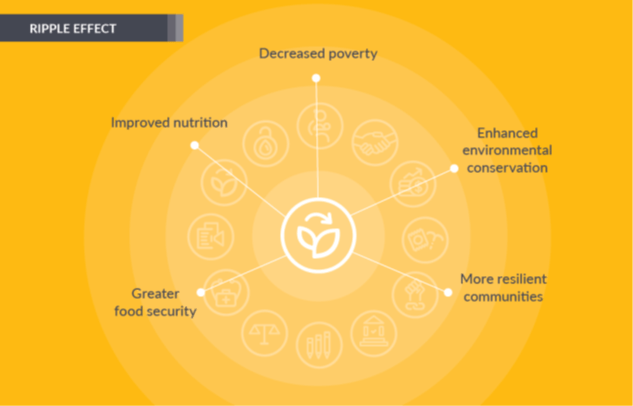
Research shows that greater female representation in parliament leads to more stringent and genuine climate policies. Yet, only 35% of environmental ministries have a gender focal point (womendeliver.org) Increasing involvement of women in decision-making capacities, especially regarding natural resource and land use is sound policymaking for climate-resilient communities, which has a ‘ripple effect’.

Source: http://www.womendeliver.org

UN Women has identified 5 useful ways to build gender equality globally. Some of these actions are policy-based, others also require a shift in mindset for a transformational gender-equal future:

  1. Empower women small-holders: Increasing the capacity of female small-scale farmers and access to productive resources can help promote sustainable agricultural practices. Women often think long-term and when involved in natural resource management, have been shown to use resources more sustainably.
  2. Invest in care: Unpaid and underpaid care work that unequally falls on the shoulders of women historically is a collective good that can benefit the wellbeing of all (individuals, families, communities, and their environments etc), but much like the environment in a neoliberal model, it is treated as a commodity to be exploited. More social value can be attributed to this kind of work, as well as more supportive policies with greater investment in the care economy.
  3. Support women’s leadership: Participation and inclusion of women in leadership and decision-making at all levels of society can help lead to more sustainable outcomes. Decision-making by women often leads us away from individualism, as women have a tendency to consider wider impacts and their families, communities and environments in decision-making. It is particularly important to prioritise Indigenous women’s knowledge in decision-making processes because of the wealth of knowledge they possess about their local communities, natural environments, biodiversity and natural resource management that can benefit climate action.
  4. Fund women’s organisations: empowering women’s civil society organisations can not only help achieve the action above, but it can also help elevate those voices in vulnerable communities that might otherwise be suppressed.
  5. Protect women’s health: Research shows that women are more likely to suffer from climate-related health issues such as disease or weather-related health impacts. Women are the cornerstones of family and community life, therefore impacts to women’s health have flow on effects for collective wellbeing.  Moreover, threats to public health are threats to community capabilities, affecting climate resilience.

Although global, equitable gender-focused solutions are not yet a reality, we can draw on the lessons in this year’s IWD theme to embrace women and girls as ‘solution multipliers’ in the face of social and environmental challenges, and break the bias for a more sustainable (and collective) future.

Twosday is the day to start living in harmony with nature

Today Tuesday, 22nd day of the 2nd month in 2022 is Twosday: 22.2.2022.

Whether you are spiritually inclined or not, the repetition of numbers is bound to pop out at you. Today’s date in particular has become a source of existential inquiry It has many people wondering what the greater signification of the day is and what its future consequences may be, evoking something metaphysical in our curiosities.

Numerology or the study of number symbolism can be traced back to Ancient Greece in 500BC when philosopher and mathematician Pythagoras developed a theory between numbers and their association with musical notes, which then became symbolic of individual’s personalities by tracing their birthdates. Numerology has since taken on many forms from biblical, philosophical, and cultural.

To numerologists, the number 2 symbolises harmony and cooperation, the union of basic dualities in nature. Its biblical signification brings about the unification of two forces.

Scientists have said that there is no scientific basis in the theory of today’s date. But at the very least it is culturally rooted in the aspiration to create shared meaning. Of course, I’m going to put an environmental spin on this.

For most of modern history, human societies have created a duality between the natural and human worlds, which has arguably been at the root of much of our demise – both social and environmental. This separation of worlds has been demonstrated to be one of the primary causes of climate change, as humans seek to exploit natural resources.

There has been much work coming from scholarly research and practitioners about the need to end this divide and seek harmony and cooperation between nature and society so that we may really transform the future trajectory of the planet.

So let me plant this seed…

What if today 2.22.2022, the day associated with change, harmony, unification is the day we individually and communally change the dualist way we look at the world and understand that if we, as humans live in harmony with nature, it might have significant transformative and positive impacts on our world and climate? Whether you believe in the power of numbers or not, our dualism has to change, so why not start with today?

According to numerologists, by taking the root numbers of 2.22.2022 today’s date is associated with the “destiny number” 3, which signifies optimism. If nothing else, today can be associated with the day we changed the human-nature duality of modern-day society and started thinking about both the human and natural environments as one union. And that, if we think about long-term impacts on climate change, is much cause for optimism!

Sustaining Water Wellbeing

Our blue planet is a testament to the integral role of water to every living being on earth. Access to water not only satisfies our basic needs but our psychological needs too.

Over the summer I may have been a little quiet as I took time with my family. A large part of wellbeing is taking time to connect with our families, and ourselves and for me, the school holiday period is a good time to do that. We spent a lot of time being by the water, whether that be the ocean or the rivulet. The ambiance of water – blue space – has therapeutic effects on human health and wellbeing. The time spent by water was a timely reminder that we are connected to the liquid stuff in more ways than we realise.

Our blue planet is a testament to the integral role of water to every living being on earth. Access to water not only satisfies our basic needs but our psychological needs too. Our need for water can be categorised by Manfreed Max-Neef’s nine axiological needs for Human-Scale Development, that is: subsistence, protection, participation, identity, idleness, creation, and even affection, understanding and freedom; but which also corresponds to Maslow’s psychological needs mirrored in his Hierarchy of Needs such as the need for leisure time, culture and community. Oftentimes, water is only equated to the need for subsistence or survival.

Water is a communal concept. The only thing individual about water is the way its presence makes us feel, subjectively. Yet, even that has objective consequences because, numerous studies show that being connected to nature, particularly water, makes people feel part of something bigger than themselves, imparting a feeling of awe and transcendence. This feeling of being connected to something bigger helps develop the responsibility to protect the environment around us.

Given the overwhelming importance of water to life on earth, the principle of reciprocity is especially crucial. In other words, being cognizant of the society-nature continuum and conscious of the fact that what we take, we must also give back. The Socio-Eco Wellbeing that results from Buen Vivir, confirms transcendent values like our deep connection to water, highlighting the importance not only of human wellbeing but also environmental wellbeing.

The United Nations resolution 64/292 calling for access to safe water to be considered as a human right was passed in 2010 with the support of 122 countries. It states that “the human right to water entitles everyone to sufficient, safe, acceptable, physically accessible and affordable water for personal and domestic uses.” (UN CESC – General Comment 15, paragraph 2).

Although no one can deny the necessity of water as human, and the need for everyone, everywhere to be able to access clean, safe water, it has been argued that making it a human right only reinforces the mentality of human’s dominance over nature – that we must control it as a means to ensuring our own survival and livelihood, cementing if you like, the idea of water being a commodity. It should not be.  Rather, it should be understood as an essential part of the earth’s lifecycle, of which we are also a part.

Our modern-day commodity-like dependence on water leads to pollution, drought, water scarcity, and consequently diseases and food insecurity. Notwithstanding our absolute need for clean, fresh water; shifting mindsets from water as a human right to the responsibility of humans to ensure the health and sustainability of water sources can help ensure the former. Of course, this would not be equitable without re-examining the structural causes as to why many communities go without safe drinking water, and sacred water environments destroyed, polluted, or even seized.

In neoliberal development, human rights and environmental protection are often in conflict with each other. In 2010, the United Nations Human Rights Council affirmed that the human right to water is legally binding upon states. To guarantee water as a human right means first addressing the structural and systemic road bumps that see the misuse, overuse, and exploitation of water and water sources. A large part of this is due to industry consumption. Particularly in communities in the Global South which have had multinationals and/or governments misuse and pollute local water sources for production’s sake. Watercourses are protected internationally by the “no-harm” principle in international law. That may help with seeking reparations,  but there is nothing concrete to prevent harm being done in the first place.

Harms to water sources create water stress, not only for humans but also for all living ecosystems that rely upon water for survival. The consequences are dire and cyclical. It affects food systems, livelihoods, even reactional activities. In short, it affects both human and ecological wellbeing and threatens our ability to satisfy both basic and psychological needs.

So, let’s put a spin on this. If we viewed water not as a right, but as a guarantor of both human and ecological wellbeing that must be protected and cared for to be utilized, would that change anything? Should it then not just be a question of society’s needs, but environmental ones too? The first step might be to also ask: what does water need to ensure its continual and safe replenishment?

Personifying ecological resources, for example, is a practice and worldview taken by Indigenous Peoples for generations, and it may help better ensure sustainability by changing the way we look at our natural resources. This practice has been ratified in law in a handful of cases where local jurisdictions uphold the Rights of the Nature, such as the constitutional amendments in Ecuador which recognise such rights, or the treaty ratified in New Zealand with the Māori iwi recognising the Whanganui River as a legal entity.

Complementing the right of water should therefore be the application of environmental personhood – providing water itself rights to exist and survive in good health. These two ideas need to harmonize each other because, without water, there is no life – human or otherwise. On the contrary, without humans, water will continue to flow and perhaps thrive, without the threats of overuse and pollution. Unfortunately, we humans cannot say the same about water.

The Path to and Beyond COP26: Why its Important and what needs to Happen

Photo by Markus Spiske on Pexels.com

Part I – Time for planet altering commitments

We are in the lead up to the most pivotal climate conference in history, from which the outcomes have the potential to either send us full throttle towards climate breakdown and biodiversity loss well beyond 2 degrees warming, or provide us with the last exit – one last chance to redeem humanity’s future and limit warming to below 1.5 degrees Celsius.

“We can either save our world or condemn humanity to a hellish future.”

António Guterres

The pressure on our global leaders from civil society to achieve the latter has never been so high. An overwhelming number of people around the world have listened to the climate science and now want those in power to act with urgency and resolve, rather than continue the conflated lip service we have heard from environmental negotiations over the past three decades.

What is COP26 and why is it important ?

The planet has already warmed by 1.1 degree since the beginning of the industrial revolution and the jury is out as to whether the 1.5 goal is still possible. In July this year global surface temperatures were the highest since records began in 1880. The IPCC 6th Assessment Report released in August found that global warming and sea level rise is happening much faster than scientists originally predicted.

Source: United in Science 2021

Between 2019-21, we have witnessed an unprecedented number of extreme weather events around the globe. Instead of decreasing, CO2 emissions have reached historical levels in May 2021 at 419 parts per million. These figures only make it more crucial that we try everything within the realm of possibility to avert climate catastrophe. There are thus unprecedented expectations of the November conference.

In the lead up to COP26 there have been a number of key climate discussions at a multilateral level. In July, the G20 debated (albeit divisibly) the need for stronger climate action. In August, the UN General Assembly kicked off its 76th session with an assessment of the Sustainable Development Goals.

As host, the UK has mapped out four main goals for COP26, which include :

  1. Securing global net zero by mid-century and keeping warming to below 1.5 degrees by : phasing out coal, preventing deforestation, switching to electric vehicles, and proliferating renewables.
  2. Increasing focus on adaptation to protect communities and habitats.
  3. Mobilising $100 billion of climate finance to developing countries, which has fallen below the previous pledges.
  4. Working together to deliver key commitments by accelerating collaboration and finalising the Paris Rulebook (how countries implement the commitments of the Paris Agreement, namely through Nationally Determined Contributions, or NDCs).

Thanks to Prime Minister Scott Morrison, Australia is reinforcing its role as the climate villain of COP26 for lack of commitments for robust action. Not only does Australia not have a NDC, missing the 31 July deadline set out in the Paris Agreement ; but Morrison has tried to convince the UK to scale back key climate commitments in the bilateral trade agreement, and suggested he might not attend the November meeting. As it stands, UN Secretary-General António Guterres warns that current NDCs will lead to a “catastrophic” rise of 2.7 degrees. This will imminently lead to rapid climate breakdown.

Why COP26 is not everything

The reality is that since global governance on curbing carbon and other atmospheric emissions began all those decades ago, the level of CO2 in the atmosphere has not decreased, but increased 40%. While we need strong governance and genuine policy commitments in place on a multilateral scale, we also need national governance that reflects the climate crisis, community-level cooperation to lead effective change on a daily basis, corporate buy-in to make transformation possible through technology and innovation, and organisations to act as mediators between these actors and call out agenda pushing.

The COP26 goal of ‘Working together’ must be a genuine commitment to including a wider range of voices at the table. In that respect, the (im)balance of power that has led climate action to date needs to change. I’ll explore what that might involve in part II.